



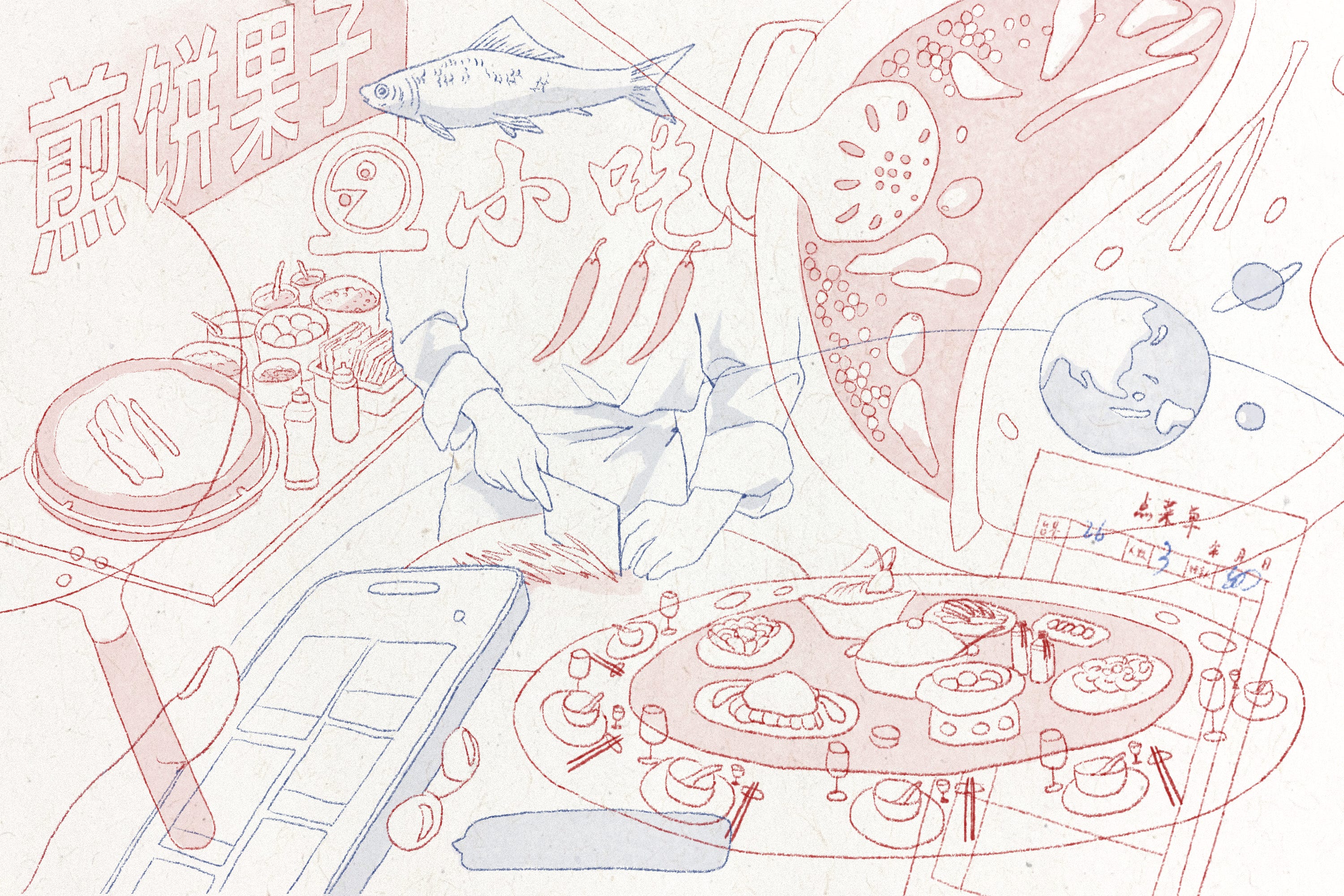
Illustration by Yanki Kung

Years ago, when I was reporting on Fuzhounese immigrants in Manhattan’s Chinatown, I sat down with the chef of Yung Sun 榕信酒楼. “Order from the other side,” he said, flipping the menu, pointing to Fuzhounese snacks like ròu yàn 肉燕. On the front were Cantonese and Chinese American classics: lo mein, moo shu pork, clay pot casseroles. On the back was where his hometown delicacies lived, under the heading “Foochow style.” He told me it was set up this way because, back then, when people walked into a Chinese restaurant, they expected Cantonese food.
As growing numbers of Fuzhounese immigrants arrived in the U.S. in the 1970s and ’80s, many through New York and by sea, Manhattan’s Chinatown was still dominated by Cantonese culture. For many Americans, that first contact with Cantonese cuisine shaped how Chinese food was represented, giving rise to a canon of Chinese American cuisine. Immigrants who arrived later, from other regions, had to appeal to the popular understanding of what “Chinese food” was, while sneaking in the food native to them almost like contraband.
For many in the Chinese diaspora, leaving home is the first time we realize that “Chinese” is something others see as weird, singular, and fixed—a thing to be encountered rather than simply lived. There is a strange feeling in that discovery: both estrangement and recognition, as if you are looking at yourself in a distorting mirror. I had the banquet-hall dim sum experience for the first time in Maryland, and my first bowl of wonton noodle soup at a stall in Manhattan’s Chinatown. None of these experiences directly remind me of home.
Indeed, the idea of Chinese food has always been plural, nebulous and constantly reinvented across generations of immigrant and cultural contexts. In New York City, Chinese restaurants that cater almost exclusively to the newer generations of Chinese expats now stand alongside restaurants that speak to a much broader audience. Food trends that have already peaked or faded in China find second lives in Flushing. Older-generation chefs compete with new establishments built around pre-made sauce packets and scalable formats. French techniques are folded into Chinese flavors and served in Chinatown wine bars with sommeliers. The restaurants trending on RedNote and reviewed by New York magazine have never overlapped so much.
It is a confusing time to enjoy Chinese food. When someone says they are a lover of Chinese food, you rarely know what to assume. China is enormous. Its regional variations are so vast that any friend from another town could easily name dozens of ingredients and dishes I have never heard of. Outside of China, Chinese cuisines have also evolved along their own paths, adapting to and fusing with local influences. To talk about Chinese food as one thing is almost as ambitious an undertaking as packing Georgian, Italian, and Portuguese food altogether under “European food.”
The context collapses when you try to introduce the vastness of Chinese food into a new setting. Some are meant to be carried in a paper cup as an easy breakfast. Some are meant to be eaten on a hot summer night by the street. A lot should probably never have been plated at all. But hey, we are in North America. What else can you say when seasonality, terroir, and traditions all come out simply as, “It’s good”?
But it is also a golden time to be into Chinese food. After all, we are all Chinamaxxing now. Food pop-ups and private dinner tables seem to happen every week in New York (between the three of us, we have hosted a few ourselves). Chinese restaurant businesses of all kinds are finding their audiences. A TikTok video can summon a never-ending line outside a Chinatown joint or a Flushing cart overnight. ABCs, fobs, global transplants and Dimes Square white hippies now congregate and mingle on the Lower East Side, rediscovering the food that has kept generations of Chinese diaspora fed.

Now back to the motherland, the concept of eight main culinary traditions (bā dà cài xì 八大菜系), largely mapped to the contours of modern provinces, was only created in the 1970s and ‘80s. Today, younger diners and chefs are ready to move away from this pedantic categorization and explore a far messier and expansive view of Chinese food.
Like many nation-states, China’s administrative borders often cut across older cultural continuums, dividing places where language, food, and everyday habits may have more in common than the map suggests.
Take Caiwei’s and my home province of Hubei: the central plain is fed by rice fields and lakes that yield all edible parts of the lotus plant, as well as freshwater fish and crustaceans. Further west in Yichang, the food starts to resemble that of our neighbors, Sichuan and Chongqing. To the north, Xiangyang is known for its bold and spicy beef noodles, with visible influences from northern provinces like Shaanxi and Henan.
These differences within a single province make province-based culinary traditions feel imprecise, if not reductive. But these nuances also provide endless ingredients, flavors and techniques for an increasingly nationalized food scene.
This culinary abundance has proved to be fertile ground for a restaurant industry constantly searching for something “new.” In recent years, Yunnan, Guizhou, Jiangxi, and Guangxi have each cooked up waves of restaurants and dining concepts. The rise of Yunnan- and Guizhou-inspired bistros is one example, as I previously wrote for the South China Morning Post.
Rife with competition, the domestic food landscape in China has become both more diverse and homogeneous. New cuisines are constantly being introduced, but as soon as a few restaurants specializing in a “new” food take off, rapid imitation and expansion follows.
Even the boom of commercial real estate shows up in ways that could easily go unnoticed: as malls become center of gravity for neighborhoods in the past 20 years, large restaurant groups have emerged to take over prime locations with unparallelled efficiency.
Still, beneath the noise, there is a genuine interest in the unique foods, and the stories and traditions that give the dishes meaning beyond tasting good. This new food scene is driven by individual restaurants, entrepreneurs, young diners with a growing appetite for new flavors, as much as by, of course, the internet. The dominance of social media apps such as Rednote (Xiaohongshu) and Dianping has fed an insatiable appetite for novelty, and created its own unique scene of foodie culture, one that is more participatory, playful and creator-driven.

Chinese food culture has an everyday pervasiveness that feels different from the English-language food scene. It is not a niche interest or lifestyle vertical, but closer to a common language shared across class, hometowns, taste, status and age groups. Food is easily the safest topic for small talk (albeit whether small talk culture itself exists in the same way is a question). It is probably no surprise, then, that one of the most common greetings is “chī le ma 吃了吗” (which literally means, “have you eaten yet”)!
That means the average Chinese person (especially if they are an internet user) has a much more granular vocabulary about food. They might not belong to the social class or image traditionally associated with connoisseurs, but they can still argue intensely about whether a noodle texture is right, whether a regional cuisine has been overblown on social media, whether a restaurant is worth a visit, or whether a food is zhì shāng shuì 智商税 (literally, tax on low intellect, or a gullibility tax)—a common internet phrase for something that preys on gullible consumers.
This stands in sharp contrast to the U.S., where the everyday food landscape can feel a little flatter: dominated by familiar industrialized flavors, with less regional distinction, and shaped by a wistful longing for immigrant “authenticity” that too often reduces criticism of immigrant food to well-meaning but generic praise.
In China, with the relative absence of an institutionalized food-media or professional critic class, a different kind of food culture took shape online: one in which every sufficiently opinionated internet user gets a say. Over time, diners developed their own unwritten rules, vocabularies, and standards for evaluating restaurants. There is a whole vernacular of bì léi 避雷 (warning others away), cǎi léi 踩雷 (trying something and regretting it), zhòng cǎo 种草 (being influenced to want something), and dǎ kǎ 打卡 (checking in at a hyped spot), alongside endless unofficial rankings and fiercely debated local lists.
It is a process that is not immune to the common criticism of the internet hype cycle, but also one that is filled with genuine insights, humor and play. It is within this process that old staples get contested and new classics get created.
People also cook at home with the help of screens now. Tutorials from chefs, influencers, and ordinary home cooks pile up across the internet; in the comments, people submit their “homework,” compare results, troubleshoot failures, and sometimes review the reviews themselves. Together, they form a vast, largely organic trend machine that constantly metabolizes new influences, information, techniques, and aesthetics.
It’s no wonder, then, that for many Chinese people abroad, figuring out where to eat in a new city often starts—and sometimes ends—with Rednote. There are no institutions or authority there, just a lot of people arguing, ranking, and tirelessly teaching each other how to eat. For those of us far from home, Chinese social media is still the most trustworthy voice in the room.

Back in 2020, Alison Roman, then the star recipe columnist for the New York Times, dismissed Chrissy Teigen and Marie Kondo in an interview for building their commercial empires. Meanwhile her own recipes, along with those of many personalities across legacy food media, were built on immigrant flavors without due credit. In the wave of reckoning that followed, established brands like Bon Appétit scrambled to put out apologies, audit their archives and vow to be more sensitive to proper crediting and representation of minority voices.
Yet recipes remain dominated by buzzwords and the familiar miso-tahini-gochujang complex. These ingredients function as passports for unfamiliar dishes to travel through immigration, while inevitably flattening the specific stories and traditions that birthed them.
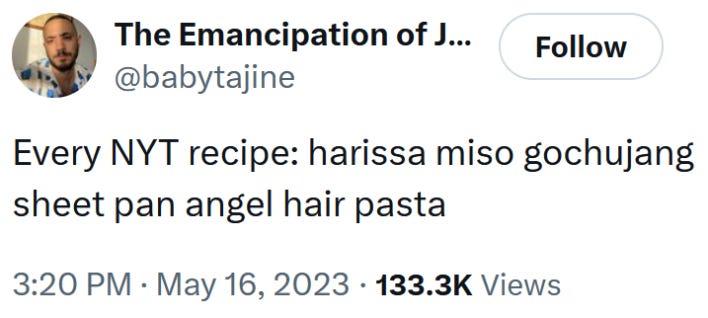
For better or worse, Chinese food doesn’t even have many buzzwords to claim as its own. And most “Chinese” recipes online are largely internationalized versions of dishes, shaped less by what people eat in various parts of China, but more by what Western editors and readers recognize as Chinese. The fact that Chinese people from different parts of the country sometimes cannot even agree on what to call an ingredient or a dish does not help either.
In a world where food writers and diners are only beginning to recognize the full breadth of Chinese food, it still feels like a distant dream for all the cuisines beneath that umbrella to shine on their own. Discussions of deeply regional Chinese restaurants often amount to little more than mentions—a nod to their existence rather than stories in their own right. Part of the problem is context, an exhausting amount of groundwork that is sometimes deemed as optional or simply unnecessary. A piece about the latest Italian restaurant in New York can draw on regions of Italy and drop words like mafaldine and orecchiette; a profile of a Yunnan noodle shop may still have to begin by explaining where Yunnan is.
That missing context also obscures how foods are meant to work together. On Chinese tables, meals are anchored by zhǔ shí 主食, the essential grains and starches that form the core of the meal. For a hearty everyday dish, xià fàn 下饭 is one of the highest compliments: literally, how well it “sends the rice down,” or how powerfully it makes you want to take another bite.
Chinese and English also practice different approaches to tasting food. The Chinese palate places an emphasis on texture and mouthfeel, but the English language struggles in being more specific about the different chewiness, slipperiness and crunch. If you’re interested in exploring this linguistic gap further, Ligaya Mishan’s 2023 New York Times essay offers a thoughtful cross-cultural perspective, while Fuchsia Dunlop’s Invitation to a Banquet includes a survey of the many Chinese texture descriptors.
There is also, of course, politics. Because of its earlier rise to global prominence, Japan has become the source of many ingredients used throughout East Asia and beyond, such as edamame, shiitake, and gyoza. What is named first often becomes what is seen.

The longer I live away from China, the less coherent and more expansive Chinese food becomes to me. I have lived in the U.S. for six years now, and it is through living in New York as a new Chinese immigrant that I learned about things I never grew up knowing like different styles of rice rolls, the Fuzhounese standard for fish balls, the difference between General Tso’s chicken and orange chicken. Little did I know I would come to crave them all.
I learned to rejoice in finding the “close enough” version of a regional Chinese dish thousands of miles from where it was born. I developed opinions on what does and does not belong in yān dǔ xiān 腌笃鲜, something I never grew up eating. I began going out of my way to gather people around a home-cooked feast for every traditional Chinese holiday.
But what is even tradition? Wuhan staple hot dry noodles (or, rè gān miàn 热干面) were invented in the 1930s; shuǐ zhǔ yú 水煮鱼, or spicy boiled fish, took its modern form in Chongqing in the 70s and 80s; and even tomato and egg, something close to a national home cooked dish in China, has been around for barely a century. If anything, constant reinvention is the tradition.
But that doesn’t mean anything goes. We know what we know, and it’s hard not to say something when everyone else is getting it wrong. We have so many “iykyk” moments—we live with a specific kind of cognitive dissonance that comes from moving between two languages, two food cultures (if these are even quantifiable) and two ways of explaining the world.

I couldn’t have said it better than my friend Ruby Justice Thelot, who wrote in his essay “In Praise of Gatekeeping”:
The Gatekeeper is important because they provide the friction. The Gatekeeper is not truly exclusionary, rather they introduce labor to access the culture, they introduce a rite of passage, of initiation. The gatekeeper creates the fence which the enthusiast happily hops and stops the dilettante.
Numb and Spicy came out of conversations like these. Yanki and I met in New York and became partners in crime in hosting dinner parties; Yang and I met at a media-world social and somehow spent an hour standing in a corner talking about food. The conversations kept going—over meals, over calls, across cities—until it became obvious that we wanted somewhere to put them.
Having written about China for English-language media for my entire career, I know the process almost always starts with “what do I find most interesting and fun?”—but that often gets drowned out by “why should American readers care about this?” and “why is it important?.” And when talking across differences starts to feel like an endless exercise in explanation, translation, and defense—what if we simply talked to each other instead and invited anyone curious enough to listen in?
What if we can contribute to a culture conversation not shaped by authenticity policing or NYT Cooking-style “buzzword burger,” but by a genuine desire to sit at the same table with each other?
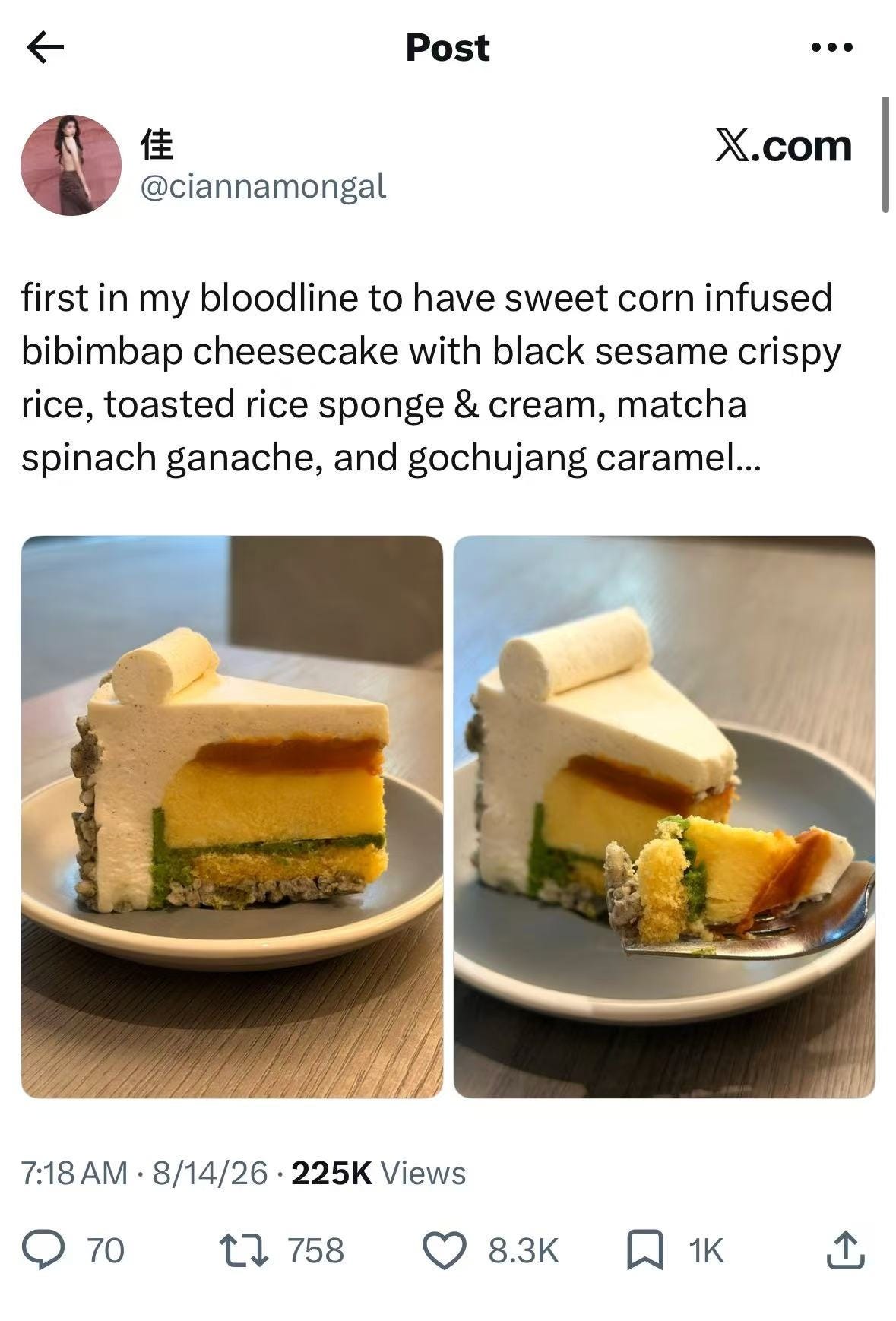
What if we didn’t always have to justify ourselves to the world? What if we could simply be, become, and keep becoming—and invite you along for the ride?
We are inspired by early food Substacks like Vittles, indie print projects like Cake Zine, the in-the-know voiceyness of Feed Me, and the diligent efforts of peers like Chinese Cooking Demystified. I am also forever inspired by the first Substack project I worked on, Chaoyang Trap, where a group of friends and I wrote about having fun on the Chinese internet. I find myself missing those days, and if there’s one thing I’ve learned from that, it’s that sometimes you can manifest the kind of audience you want into existence.
Our name comes from a slightly-off translation of má là 麻辣, the signature flavor from chili pepper and Sichuan peppercorn, representative of Sichuan cuisine and many Southwestern Chinese dishes.
Chinese speakers have long used the “five flavors” to capture a mixed emotional state. wǔ wèi zá chén 五味杂陈, a commonly used chengyu idiom, literally means “five flavors all at once.” The phrase suān tián kǔ là 酸甜苦辣—sour, sweet, bitter, spicy—is often used as a catch-all for life’s full range of experiences and emotions.
麻 má, or numbing, hasn’t traditionally been part of that emotional vocabulary—but that’s changed with the internet. Phrases like “我麻了” (“I’m numb”) and “赢麻了” (”winning so much I’m numb”) have become popular Chinese internet slangs over the past decade. We love them because they capture the buzz, the tingle, the strange feeling of being both overstimulated and slightly numb.
For us, Numb and Spicy is about food, but it’s also about that state of being—rawdogging this immigrant life with no manual, half-overwhelmed and half-numb to it, and still, somehow, wanting more.
You’ll see these things from us:
Essays, like this one, about Chinese food experiences and opinions broadly
Recipes and guides—sometimes traditional, sometimes unconventional—written from a place of familiarity and respect
On-the-ground reporting, dispatched from everywhere we encounter Chinese food
Trend pieces translating and interpreting food conversations happening in Chinese, especially online
Interviews with restaurateurs, home chefs, connoisseurs, farmers, and anyone else in the food world we find interesting
Graphic essays from our one and only Yanki, about her food feelings
Other things we feel strongly enough to write about
We want to be your favorite gatekeeper. If you want to chat, you can reach us all at editors@numbandspicy.com.
About Writers
Yang Xiong is a consultant-turned food and travel writer from Wuhan, China. He is currently bouncing between places in China with good food (which is practically everywhere) and New York (where he cat-sits for old friends). A genetic test has confirmed his fondness for high-calorie food, which is true, so he’s trying very hard to manage this vice with lots of tennis.
Yanki Kung is an artist from Shenzhen, China. She is currently based in Toronto, arguably the capital of Chinese food in North America. With a background in cultural anthropology, she now illustrates, tattoos, writes, does stand-up comedy, hosts a podcast, and cooks at a Japanese restaurant. She throws a lot of dinner parties.
Caiwei Chen is a writer, journalist and critic from Xiangyang, China. She currently lives in Sunset Park, Brooklyn, where she finds therapy by wandering through the grocery stalls along 8th Avenue. She also reports on tech, AI, internet and thinks about how these things impact society more broadly. She has, at various points, been the designated China woman at an American media organization. She is more online than she likes to admit.
Your argument that Chinese food is plural, regional, diasporic, and constantly reinvented gets at why the single label can be both useful and distorting. I especially like the point that everyday diners in China carry a granular vocabulary rather than leaving judgment to a critic class. I’m Hailee in Chengdu; this essay looks at a related moment as ordinary Chinese habits become newly fashionable abroad: https://chengdugirlhailee.substack.com/p/everyone-is-becoming-chinese-but
牛逼。 Bring it on! Nothing more interesting to me than this.