


Editor’s Note: This issue is a collaborative post between Numb and Spicy and Peking Quack by Xinrou Shu.
In this essay, Xinrou visits one of Shanghai’s hardest-to-book restaurants and explores how Chinese food travels abroad, is reinvented by immigrants, and returns home as an exotic, cosmopolitan experience, often with a higher price tag and a new kind of cultural prestige.
Illustration by Yanki Kung
1
In Shanghai, you’ll never run out of new restaurants to try. After all, it’s China’s most cosmopolitan city. Here, tourists line up outside time-honored restaurants for a taste of old Shanghai, expats seek out cozy Chinese fusion bistros as a cultured choice, and Chinese urban connoisseurs book ahead everything from under-the-radar spots to the city’s most hyped openings, ready to join the buzz, and, if the meals warrant it, post a review on RedNote.
The best way to exert cosmopolitanism is to add a touch of foreignness. You would be hard-pressed to find this anywhere else in China: at Penicillin, a bar on Asia’s 50 Best Bars list, a white server adds you to the waitlist, hands you an English menu, and takes your order in English (the bar has since closed due to controversy).
The illusion feels complete with the right decor. When you walk into Egg, with its cozy loft and artfully matched wooden tables, the sheer density of international diners makes you think, Am I in Brooklyn? Call to make a reservation at Ginger, and you’re greeted with a warm “How can I help?” in English. At Omills, a Filipino server walks you upstairs, shows you to the table, and takes your order, again in English.
Don’t get me wrong. There are plenty of no-frills local restaurants worth trying. But to fully experience-maxx at some of Shanghai’s trendiest spots, a certain English fluency feels like a prerequisite. In a city that has long prided itself on its hǎi pài 海派 identity—a term coined in the 1920s to refer to Shanghai’s blend of Chinese culture with western influences and modern commerce—the performance of foreign sophistication has become a selling point in its own right.
Two and a half years of living here have tamed me. I’ve developed a certain masochism about dining out. As a self-proclaimed connoisseur of Chinese urban life, I spend an embarrassing amount of time on RedNotes looking for restaurants. To eat well, you have to submit to the restaurants’ macho demands. Some make you book months in advance through an opaque, invitation-only system, while others seem to think snobbery is the new hospitality. I can put up with all of it, as long as the food is good.
That’s how I came across 八 Eight, a hard-to-book new spot offering a contemporary take on Chifa, a Chinese-Peruvian culinary tradition that blends Cantonese techniques with Peruvian ingredients and flavors. I was caught in a swirl of RedNote posts about how creative the dishes were and how fun the chef was. Two things in particular hooked me: A white chef was doing what looked like inventive riffs on Chinese food and Chinese diners were losing their minds over it.
Since its opening in May, I’d been checking for reservations casually. Then, one Wednesday night in October, I happened upon an available spot. I booked immediately, feeling the thrill of gaining entry to somewhere exclusive. Not quite as exciting as getting into Berghain, but close.
Its chef, Gabriel Rodriguez, known as Gabo among diners, is hardly a newcomer. He formerly worked in Alinea’s kitchen at, and opened the restaurant 8 by Anarkia, Eight’s predecessor, in 2023. After 18 years of living and working in Shanghai, he has established a reputation. Much of Eight’s appeal lies in its chef’s table experience, which operates on a simple premise:
Don’t expect a fixed menu. Instead, Gabo cooks spontaneously based on whatever ingredients he gets from the market that day.
Do expect the chef’s extroverted personality. People call it “fun dining” on RedNote because Gabo chats with you as he cooks, pours you a drink on the house, and slips in an extra dish. Every course is like a blind box with a hit of dopamine. His multicultural background adds to the allure: of Moroccan and British heritage, Gabo lived in New York, London, and Tokyo before settling in Shanghai.
The restaurant sits on Yongkang Road, a favorite stretch for vloggers filming their Shanghai city walks. The globally viral −86°C Dirty coffee shop is right across the street. At the door, a small brass lamp lit a green plaque on the plaster wall, with a gold 八 (Chinese character for right) above its English translation. I pulled open the door to find a staircase and an eight-seat chef’s counter. Downstairs, the counter takes up to four pairs of diners a day for a chef’s table experience without a menu. Upstairs, the newly opened dining room has mahjong-themed decor and two set menus.
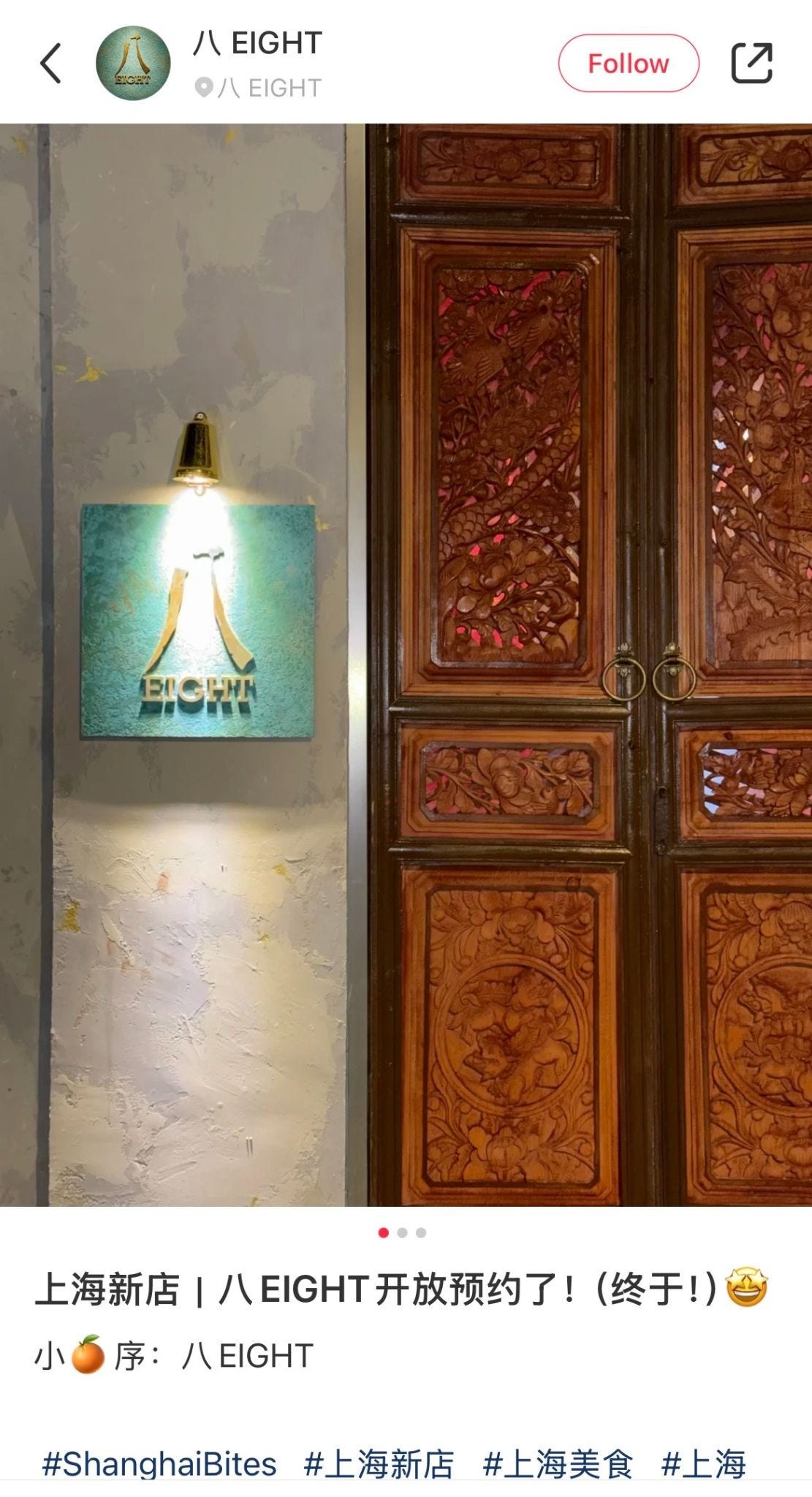
I did my research before the meal. The multiculturalism is central to Gabo’s vision for Eight: transforming the diasporic Chifa tradition into what he calls “Chifane,” or “吃饭e料理” in Chinese, a playful riff on chī fàn 吃饭, the Mandarin word for having a meal.
“It’s not a copy of any one culture, but more like traces left behind by many different places, which eventually grow together quite naturally. In fact, many of us in this generation are the same. We may have lived in different cities, and each place leaves something behind,” the restaurant’s co-owner, Aliz 阿栗子, wrote on RedNote, explaining the philosophy behind Eight.
As soon as I walked in, Gabo asked for my code. Confused, I gave him a blank look. He pointed me to the reservation code in the WeChat mini program. Was this the WeChat version of Open Sesame?
Sitting down, I didn’t know what to expect. The thing about a chef’s table is that you have to overcome the initial awkwardness, break the ice, and somehow build rapport with a stranger over the course of a dinner. It feels like hopping on the Friendship Express, or simply chef-diner speed dating.
2
The trouble with eating from someone else’s imagination is that they may not feel obliged to explain it to you.
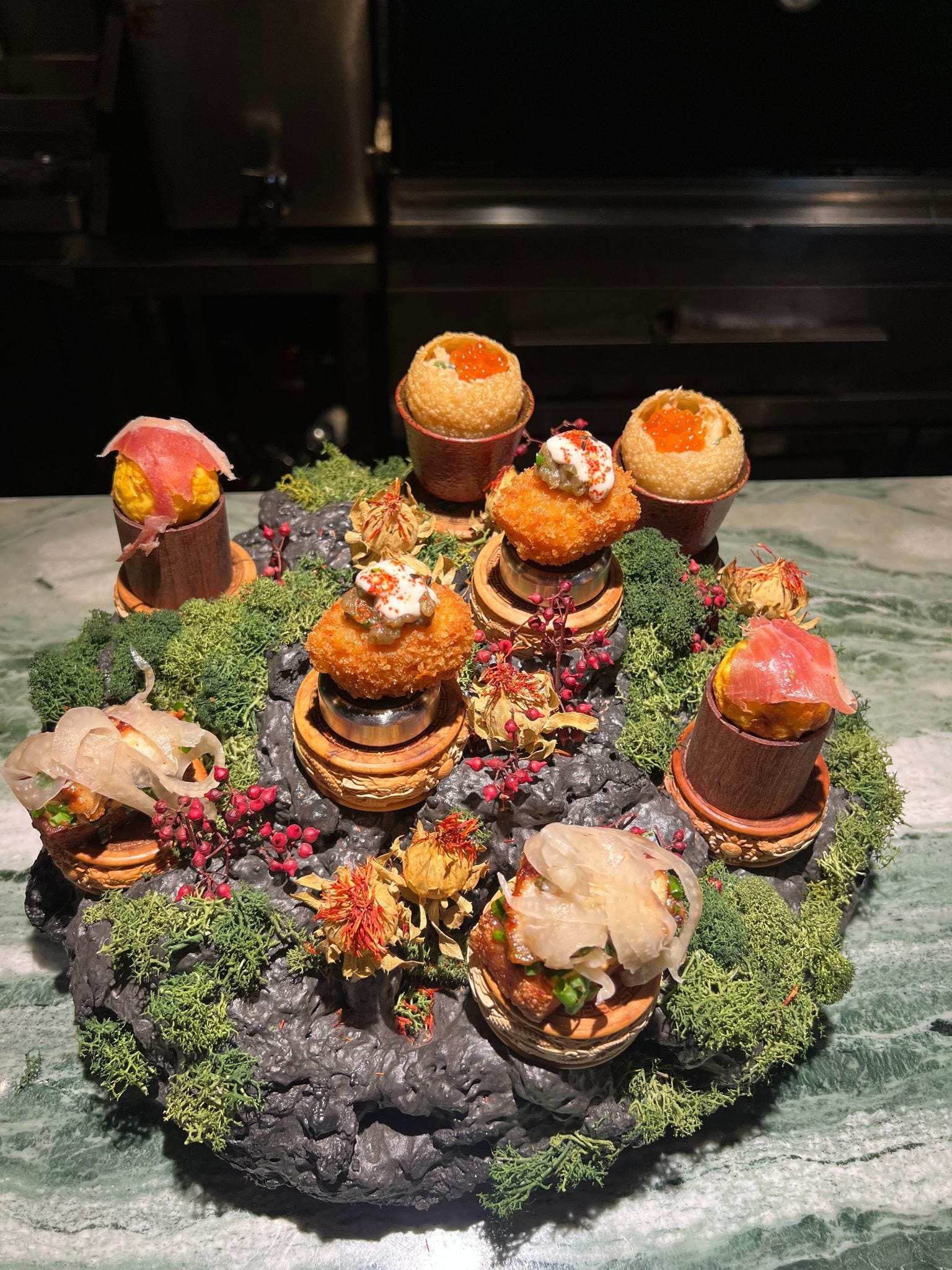
There were six courses in total. The first consists of four appetizers arranged on a chessboard-inspired plate. I had no idea what I was eating. When I asked, Gabo told me, “Don’t ask, just eat.” Fair enough. I managed to figure out only one of them: eel over turnip cake, or luó bo gāo 萝卜糕, sprinkled with shredded onions and scallions.
The second course was mud crab, which Gabo had picked up at the seafood market that morning. Holding the crabs, he mused aloud, “How should I cook them?” He eventually tossed them on the grill to give them a nice char before seasoning them with pepper and his homemade chili oil, which he called his special Lao Gan Ma.
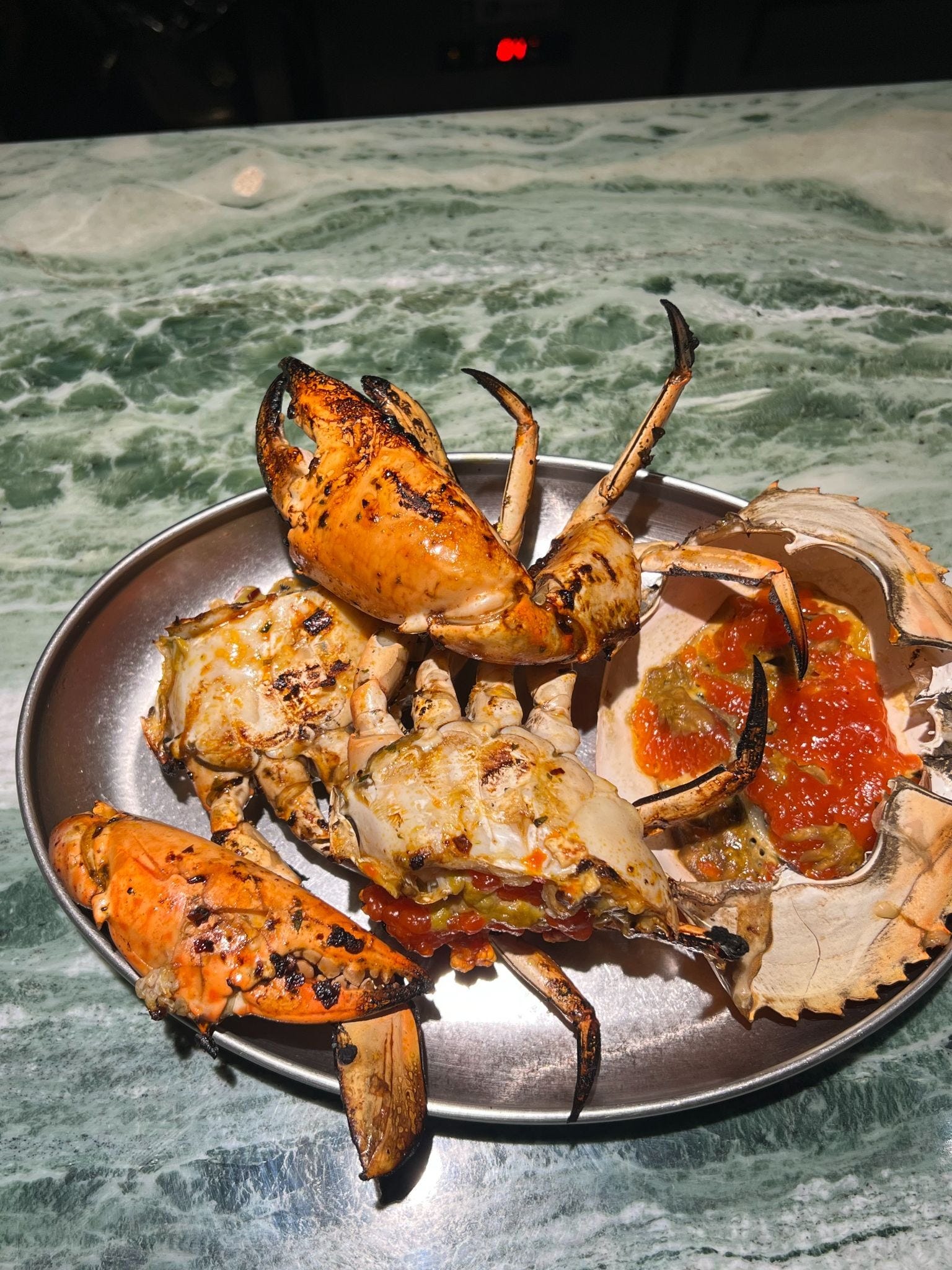
For those who don’t count crab as meat, Gabo had you covered. I hadn’t expected roast chicken after the crab, much less an aged steak on top. With a little seasoning, the grilled crab was smoky and tasted of the sea. The chicken and steak were tender and juicy, each with a rich sauce. Crispy garlic flakes gave the steak extra flavor, while pickled chilis on the side cut through the heaviness.
By the time the roast chicken and steak had come and gone, I was already full. But then came a rice dish that reminded me of paella. It was a feast for the senses: hearing the rice sizzle in the pan and seeing generous heaps of sea urchin, scallions, and baby squid glisten under the warm lights. When I pointed out its resemblance to paella, Gabo protested, “No, no, no, no, no. Totally different!” As someone born in Spain, Gabo seemed rather proud of the distinction. What he was actually going for was Chinese claypot rice.
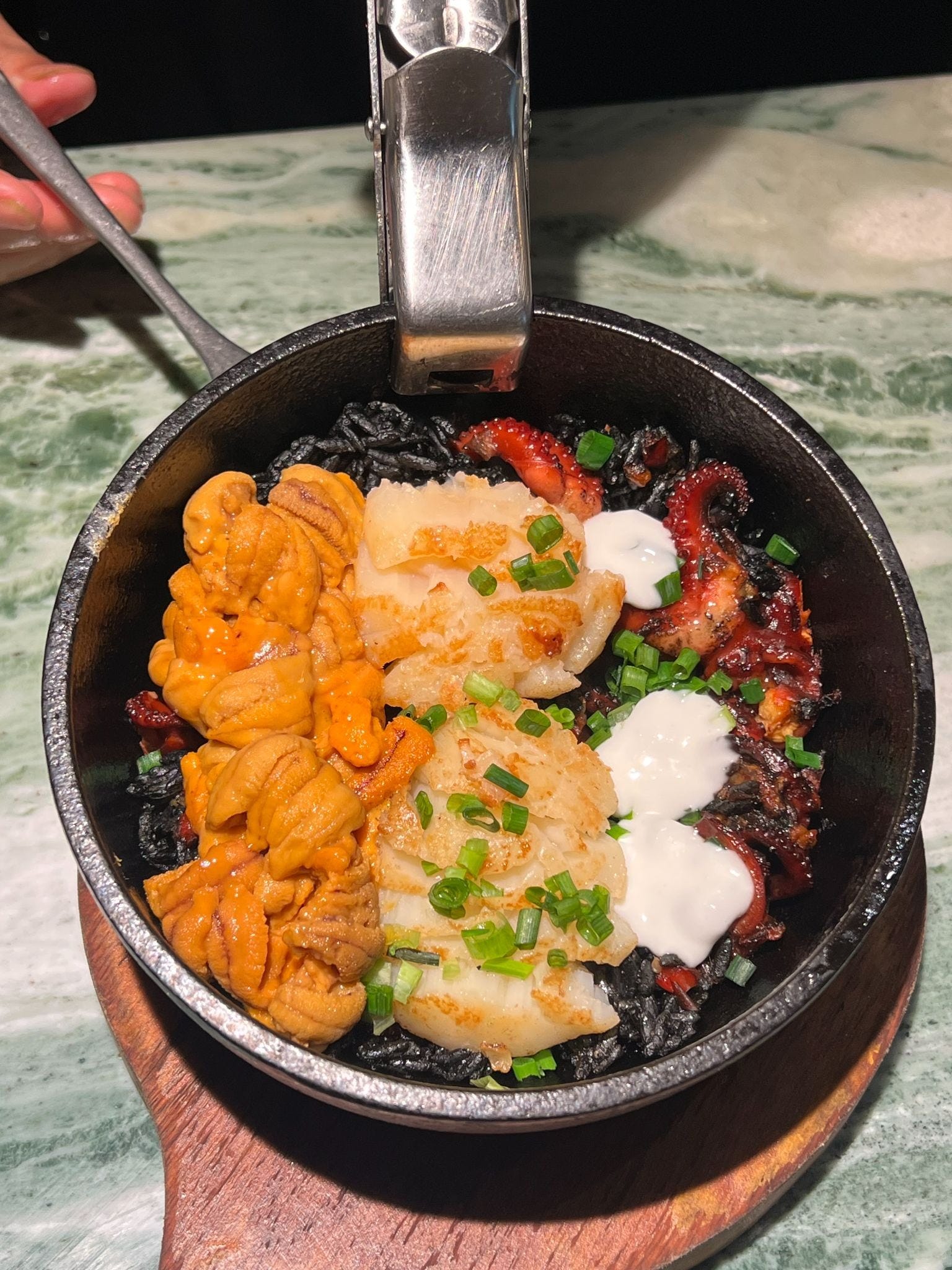
I finally blurted out the question that brought me here. “Why did you choose the immigrant Chifa cuisine? Have you ever lived in Peru?”
“I’m bringing this cuisine from Peru back to its roots in China because I’m an immigrant in Shanghai. This is my reinterpretation,” Gabo told me.
He has never lived in Peru. He chose Chifa because, in his opinion, it’s simply better than Nikkei, its (arguably more well-known) Japanese-Peruvian counterpart.
3
Gabo made a point of bringing an adapted cuisine back to its place of origin. But Chifa is just one chapter in a much larger story. Over generations, Chinese culinary traditions have traveled around the world, reinvented by immigrants and local cooks alike into new cuisines, some so unrecognizable to domestic Chinese diners that they return as exotic novelty items on restaurant menus.
In Peru, the roots of Chifa date back to 1849, when thousands of Chinese laborers, mostly from Guangdong, arrived and brought Cantonese high-heat wok cooking and soy-based seasoning into contact with native ingredients like ají amarillo (yellow chili pepper), lime, and local meats. Over time, dishes like arroz chaufa, a Peruvian take on Cantonese fried rice, became staples in everyday Peruvian food culture.
Similar transformations took place around the world. In India, Chinese immigrants who settled in Kolkata helped give rise to Indo-Chinese cuisine, adapting Chinese cooking to Indian spices and tastes. Popular dishes include Hakka noodles (stir-fried with shredded cabbage, carrots, bell peppers, and green chilies) and Gobi Manchurian (deep-fried cauliflower florets or chicken chunks tossed in a savory, spicy, and tangy garlic-ginger-soy glaze).
In Japan, Chinese dishes evolved to form a culinary tradition known as chūka ryōri that includes foods like ramen (noodle soups adapted into a Japanese classic), gyoza (pan-fried dumplings rooted in Chinese jiaozi with thinner wrappers and lighter fillings), and Sichuan-inspired Mapo Tofu that made milder and sweeter using miso, mirin, or doubanjiang. (When ramen is considered Japanese food everywhere else, it’s still classified as Chinese food in Japan!)
And in America, Chinese immigrants and restaurateurs developed an entirely new repertoire, from General Tso’s chicken to orange chicken to broccoli beef, that became so popular it came to define Chinese food for generations of Americans.
These diasporic cuisines, just like ramen, experience an identity crisis. They can be considered ordinary by one community, dismissed as inauthentic by another, and celebrated as exotic and cosmopolitan by a third. When these dishes travel back to China, they arrive with a flair of foreignness and sometimes, a new cultural cachet.
In 2023, a Chinese restaurant called Bamboo opened in Beijing, serving classic Chinese American fare. Dishes like crab rangoon would be instantly recognizable to those who had eaten at Panda Express or any American Chinese takeout, but were unfamiliar to most local Chinese diners. Its clientele, I suppose, were nostalgic Chinese students who had returned from overseas and locals curious about the Chinese American dishes they had encountered in pop culture.
In a sense, Bamboo was a novelty in the Chinese market, a fad that only survived for about a year before closing in 2024. Still, the restaurant became a social media sensation, not just for its food, but for its classic white paper takeout boxes decorated with a red pagoda, an emblem of Chinese American food so recognizable that it even got its own emoji. The box itself has a curious cultural history: originally an American invention designed to hold oysters, it became an icon of Chinese takeout in countless TV shows. (The Big Bang Theory, a wildly popular show in China, often features characters eating out of it while sitting on their couches, with chopsticks in hand).
When Chinese American food returns to its roots in China, dishes originally adapted for American customers are being sold back to their homeland as a taste of America. Orange chicken, with its sticky, sour-and-sweet sauce, has long been held up as an example of how far Chinese food has strayed from its origin. But in China, its Americanness, or the idea of America, is precisely the point.
Shanghai, as the center of China’s consumer culture, rewards novelty and cultural translation alike. Take the ABG (Asian Baby Girl) aesthetic, a popular way for urban Chinese women to perform internationalism, offering an alternative to the conventional Chinese beauty ideal of bái shòu yòu 白瘦幼: pale, thin, and youthful. Similarly, Chinese-rooted diasporic cuisine can become a trendy, upscale dining experience when presented by a well-traveled chef. Cosmopolitanism has always carried social capital, and here it rests on familiarity with the cultural codes of being international. When Chifa returns to China, it’s repackaged as a novel, intimate, and creative chef’s table experience, filtered through one chef’s personal interpretation of a tradition shaped by migration.
4
Five courses in, all six diners at the table were conversing with Gabo in English. It seems that speaking English with the chef is part of the experience, perhaps even a form of social media currency. On RedNote, diners frequently point out that knowing English is necessary to interact with the chef.
I couldn’t help but ask, “Do you speak Chinese with diners who can’t speak English?”
“If necessary, I speak Chinese,” he replied.
But according to one RedNote user, “He doesn’t seem willing to speak Chinese. When I asked him something in Chinese, he responded in English.”
For the most part, though, we talked about food, rather than me asking questions that might sound confrontational (sorry, can’t help it).
When I asked about his favorite dish, Gabo couldn’t name a single dish, but a combination: dried pork floss, leftover cài fàn 菜饭 (vegetable rice), red-braised pork belly, pr hóng shāo ròu 红烧肉 on top, and a little homemade fermented tofu, or fǔrǔ, 腐乳 on the side. It sounded like a deliciously unpretentious Shanghainese meal.
But he couldn’t serve it at Eight because, in his words, Chinese diners care too much about presentation. The chef’s table format, he explained, is his attempt to encourage interactions rather than have diners glued to their phones.
By then, we were approaching the final course, the most anticipated act of the evening: his signature caviar cheesecake. There’s no flour or sugar in the filling. The sweetness and creaminess came from his house-fermented cheese, resting on top of an almond crust. As a bonus, he served us sea urchin ice cream made from scraps he had picked up at the market.
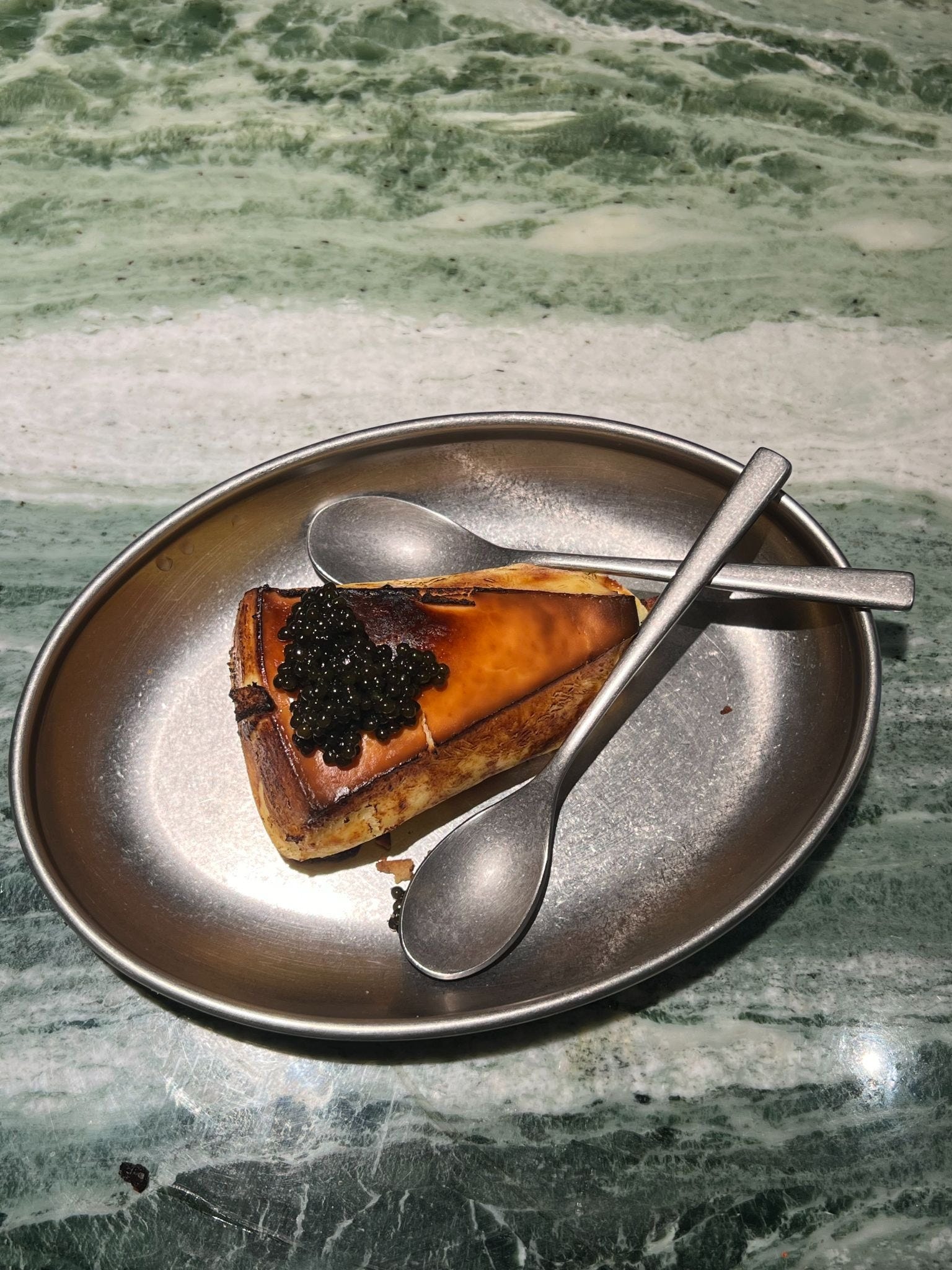
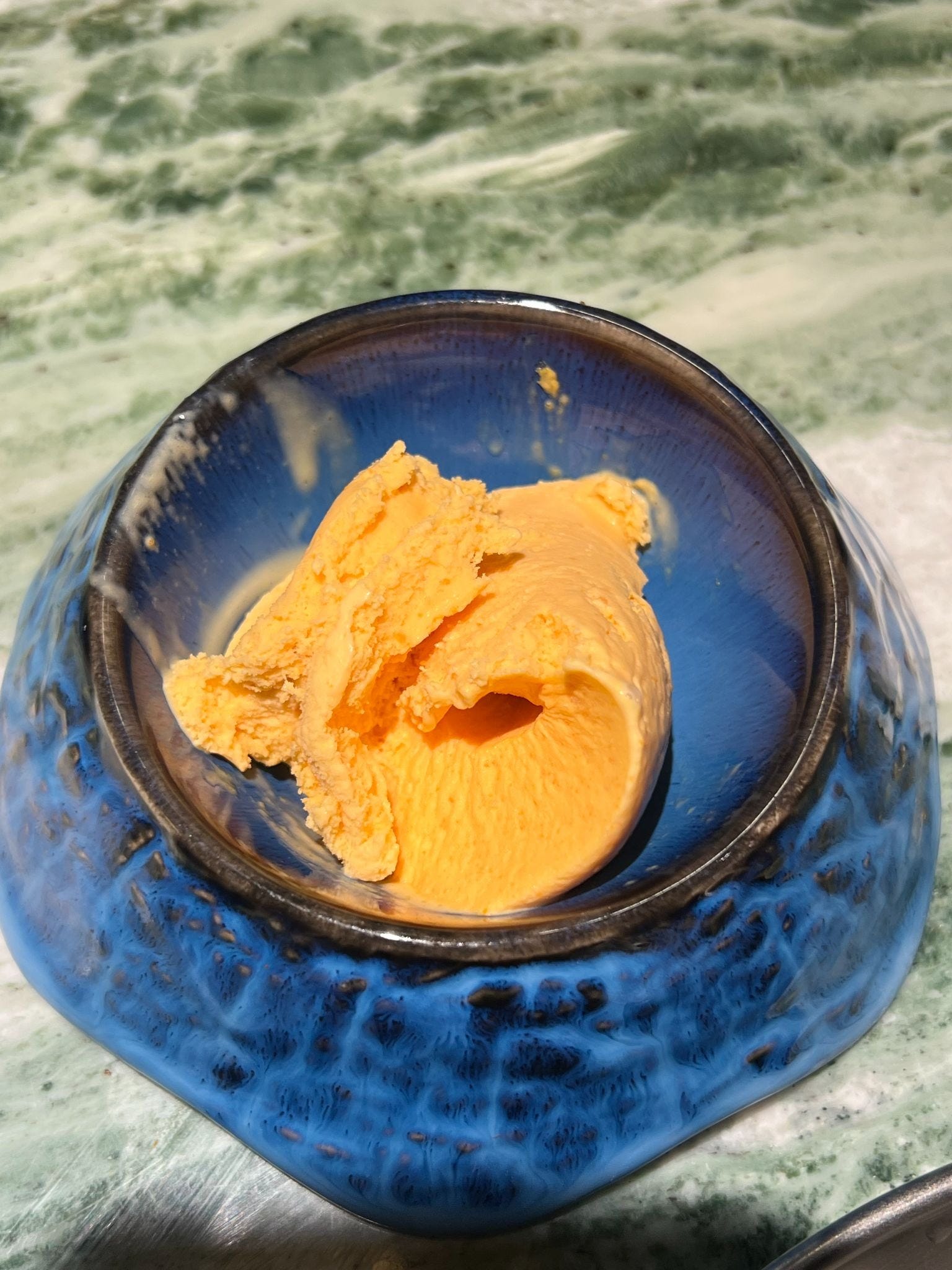
Whatever else I thought of the experience, I had to acknowledge his culinary curiosity and passion. His cooking was playful, occasionally outrageous, and full of unexpected combinations that seemed driven by genuine experimentation. It would be unfair to dismiss his culinary passion as mere cultural appropriation, or to reduce his cooking to a foreign chef’s attempt to profit from an immigrant cuisine. After all, he makes no secret that “Chifane” is his own invention, shaped by his own relationship with ingredients, markets, and food culture. If a cuisine could only be cooked by people who inherited it, and unchanged from the way it was passed down, many of the world’s most beloved dishes would never have existed.
But I could not stop thinking about the difference between how cuisines emerge and how their stories are told today.
Chifa, like many other immigrant cuisines, was developed through the accumulated work of Chinese migrants and their descendants, through restaurants, kitchens, families, and generations of experimentation. Its evolution was shaped not only by creativity, but by necessity. Immigrant cooks needed to make pragmatic decisions based on what their own people wanted to eat, what the local market found palatable, and what ingredients they could access and afford. What eventually became a celebrated culinary tradition was, for many of its creators, simply a way to make a living.
At Eight, however, the long history of migration is condensed into the story of one single chef who never lived in Peru, but whose years of living in different countries have shaped his own adaptation of the . The cuisine provides the inspiration; the chef provides the narrative.
I don’t want to dwell on whether this counts as cultural appropriation. A more interesting question is how culinary traditions acquire recognition, and whose creativity we celebrate. Gabo’s “Chifane” helps to bring international recognition that Chifa undoubtedly deserves. How can we, or why should we, disparage the fact that such a rich culinary heritage is being celebrated on a bigger stage? There is something gratifying about seeing immigrant cuisines celebrated in a fine-dining setting, especially when dishes like General Tso’s chicken have long been dismissed as inauthentic rather than appreciated as culinary inventions in their own right.
But I wonder what happens when this recognition arrives through the cosmopolitan sophistication of a celebrated chef? Can the reinterpretation properly pay homage to the tradition itself, or does the cuisine become merely a stylistic backdrop that plays a supporting role to the chef’s own imagination? Does a cuisine have to be presented humbly and authentically, with its roots intact, for its heritage to be respected?
When a cuisine built by generations of migrants becomes the inspiration for a chef’s marketing pivot, elevated by his own story as an immigrant, the heart of the question is whose creativity is most visible. After all, Shanghai is a city devoted to consumerism. Living here, you’re simply presented with two options: buying or eating. For shoppers, a “Made in China” label these days is the new “China Cool,” a niche that says more about taste than a big-name logo, at one-third of the price.
Something similar is happening at the dinner table. Fine dining has become a performance as restaurants market the history and cultural narrative to every bite, and sell it at a high price. It’s not just Eight. At Yugo Grill, Yugoslav food is the hook, and the restaurant labels itself as “the only Yugoslavian/Serbian restaurant/bar in China.” Yugoslavia doesn’t even exist anymore, but you can still go out for Yugoslavian cuisine in Shanghai without knowing much about the country or history behind the name. Eating becomes a small encounter with a culture you’re not part of, a life you might otherwise never seek out. What these restaurants are really selling is scarcity, the thrill of discovering something niche, and a version of cosmopolitanism you can buy for the price of dinner.
The meal lasted around two hours. It felt like a play. On the way home, I was still thinking about Gabo’s favorite dish, the humble bowl of leftover caifan, red-braised pork belly (or hóng shāo ròu 红烧肉), and furu he could never put on his menu. I kept thinking about how much he loved furu. Somehow the fermented tofu surprised me most of all. While eating the claypot rice, I put a dab of his furu on my spoon and scooped up some rice mixed with sea urchin. For a moment, I was a kid again, tagging along with my grandma to the wet market, where vendors sold homemade furu and pickled mustard stems out of red plastic baskets.
When I commented on the furu, calling it “the taste of the Chinese wet market,” Gabo exclaimed: “It’s exactly what I wanted to achieve!”
I believed him. But I also wondered how something so familiar to me had become, in this setting, a discovery worth celebrating. Was it the surprise of finding furu alongside sea urchin in a rice dish I’d mistaken for paella? Or was there something about hearing a foreign chef validate that this taste from my childhood was the one he’d been trying to get right? Either way, I had paid to talk about fermented tofu in English.
*all photos and screenshots by Xinrou Shu
If you enjoyed this essay, please consider subscribing to both Substacks!
The holiday season is upon us, and for our next issue, we’ve invited a stellar lineup of Chinese food insiders to share their favorite finds in Numb and Spicy’s ultimate holiday gift guide. Stay tuned!
About writer
Xinrou Shu writes and quacks. Currently based in Shanghai, she has gone down the rabbit hole of the city’s zhuliren culture. When she’s not chasing a story, she’s chasing her next meal, though the distinction is increasingly blurry. Her writing spans everything from fashion and food to personal essays and whatever else piques her curiosity about contemporary China.

Hey there, I’m the owner of 八EIGHT. Thank you so much for this amazing piece, let us know next time when you are in Shanghai, would love to host you again!🙌